Our Facebook Page to Follow: Aquarium/Pond Answers Facebook
This is a unique resource for answers, help, & advice to aquarium and pond questions not found elsewhere; With regular posts & article updates.
In our research; we use aquaculture, horticulture, medical, & university research to compile many of our articles.Our Recommended Lighting for highest efficiency professional planted/reef aquariums: "AquaRay Lighting"
Ichthyophonus in fish
By Carl Strohmeyer-PAMR 40+ years experience
Updated 1/22/19
Ichthyophonus (Ichthyphonus) are protists placed between fungi and animals in Biological classification. They are considered members of the kingdom Protozoa in the recent Biological classifications, but are still discussed with fungi in some scientific texts.
Ichthyophonusis one of the more devastating aquarium diseases. It is nearly impossible to treat, however it is easier to prevent.
This progressive disease of generally aged fish may be more common than many aquarists realize as identification is often very difficult with the proper scientific instruments and a Necropsy of infected tissue such as the heart or brain.
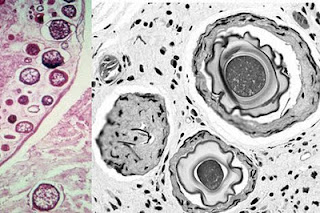
The picture to the left displays two combined slides of Ichthyophonus;
The left slide is of infected heart tissue while the right slide is of the mouth area of a different specimen (at 200 time magnification)
A few possible outer symptoms include:
Please note that with Ichthyophonus protists, a fish can have just one of these symptoms, not all symptoms are required as Ichthyophonus can metastasize in many areas of fish anatomy, often the heart or other internal tissues, but sometimes less lethal external nodules may be caused by Ichthyophonus protists.
- Ulcerated small nodules in the skin
- Bulging eyes (from pressure exerted from the infection in the brain)
- Loss of color (similar to Neon Tetra Disease)
- Loss of energy (due to the infection in the heart), as well as ability to swim normally
- Whirling; this is a common symptom that unfortunately usually is one of the final symptoms due to infection in the brain (although this symptom can appear early and be the first symptom).
However this is also a symptom of the disease called "Whirling Disease" caused by the myxozoan parasite Myxobolus cerebralis.
Further Reading/Reference: Whirling Disease (Myxobolus cerebralis) in Fish - Often Fish suffering from a systemic aquarium infection of Ichthyophonus will die off at irregular intervals, which often makes disease identification difficult.
- Since this is a progressive disease that generally affects aged fish, any symptoms that may lead one to believe a diagnosis of Ichthyophonus in young aquarium fish would likely be incorrect.
- Sudden cooling of the water can be allow this disease to go systemic as Ichthyphonus protists/fungi are generally more virulent in colder waters, so this can also be a "symptom" since actual tests are impossible to conduct in live fish (see lower in the article).
ADVERTISEMENT

The picture to the left is of a Salmon Heart, cut open to show the Ichthyophonus nodules.
These same nodules can also be present in less fatal external infections (such as on finnage).
Please click the picture for a better view.
Ichthyophonus generally affects fish as an internal fungus, often attacking vital organs such as the liver, kidneys, brain and also the muscles on occasionally. The result is often a deteriorating fish that often stops eating (making medicated foods useless), swimming in circles (loss of equilibrium caused by the infection invading the brain), and loss of color and scales.
 The picture to the right shows Ichthyophonus lesions in salmon muscle.
Modes of Transmission to Other Fish (in order of most likely mode of transmission)
- Oral route: Ingestion of infected raw fishes transmits Ichthyophonus. This is probably the most common way from my experience. Fish fed feeder fish I have noted have had a much higher incidence of Ichthyophonus.
- Skin abrasions and/or damaged gills help in transmission of the Ichthyophonus protists.
- Carriers help in spreading of Ichthyophonus protists through fecal discharges.
- The disease can transmitted by contact between diseased fish & healthy one (not well understood).
Potential treatments are:
Methylene Blue Baths or better, Potassium Permanganate Baths, increased salt levels (for fish that will tolerate this) of from 1 -2 tablespoons per 5 net gallons.
If the infection is external (such as nodules), a "Swab" with Potassium Permanganate or even Tincture of Iodine may work well, (so not use either of these treatments in the gills!!).
Generally external nodes/nodules type Ichthyophonus infections are the most treatable.
Reference: Fish Baths, Swabs
Where to purchase:
*Potassium Permanganate; Jungle Clear Water
*Kordon Methylene Blue
Some Organic Treatments such as Pimafix, Kanamycin combined with good electrolyte and calcium levels measured by a GH over 100 ppm can help as a cocktail.
A Medicated Wonder Shell would aid this cocktail by adding more anti fungal/protozoal treatment along with adding important electrolytes and calcium.
Other measures for possible treatment (or more to check the spread) are heat as Ichthyphonus protists are generally more virulent in colder waters, so raising temperatures above 82 F (28 Celsius) can at least aid in checking the spread.
Reference: Organic Fish Treatments
One very potent treatment “cocktail” (combination) is the combination of ParaGuard with AAP Spectrogram or the less synergistic combinations of Kanaplex and Nitrofuarzone (Furan 2).
Please note that this combination is a potent treatment and water parameters should be monitored carefully during this treatment (usually about 7-10 days). This should be used in addition to the before mentioned baths (with Methylene Blue or Potassium Permanganate) and water parameter corrections (if necessary).
Where to purchase:
*SeaChem ParaGuard, Malachite Green, aldehydes
*AAP Spectrogram
*Furan Two, Nitrofurazone
*SeaChem Kanaplex (Kanamycin)
*Medicated Wonder Shells
However all the above is often in vain, with the one bright spot that these procedures along with UV Sterilization will often check the spread of this disease.
Other important preventatives is to remove suspected fish to a quarantine tank, in fact I strongly recommend this (or simply euthanizing them) as this is commonly spread through the eating of infected fish’ waste by otherwise healthy fish.
Important Reference:
*Aquarium UV Sterilization; Facts & Information
Prevention of Ichthyophonus is definitely the best cure.
Here are a few preventative steps:
- Quarantine or at least give 30 minute medicated baths in Methylene Blue or Potassium Permanganate.
- Keep optimum water parameters for the fish you are keeping whether FW or saltwater.
For freshwater this includes ammonia/nitrites at 0, nitrates below 50 ppm, a stable pH, and positive ion mineralization for the fish kept (a GH of at least 100 ppm, often higher for many fish).
Reference: Aquarium Chemistry; Depletion of Positive Ions - Regular cleaning procedures
- UV Sterilization via the use of a QUALITY UV Sterilizer (NOT a Green Killing Machine, Submariner, AquaTop, or similar cheap UV Sterilizer that can only perform clarification NOT level one Sterilization)
Reference: Important Basic UV Sterilization Factors
Where to purchase: Basic, Good, Best Aquarium UV Sterilizers - Treatment with Malachite Green/Acriflavin/methylene blue based products such as Medicated Wonder Shells or Aquarium Pharmaceuticals Fungus Treatment after suspected Ichthyophonus carrying fish die or are removed.
Where to purchase:
*API Fungus Cure; Acriflavin - Increase salt in aquarium, at least temporarily to the highest levels the fish will tolerate.
See this article for more about salt use:
Salt Use in Freshwater Aquariums - Change your source for new fish, this is not to say that your trusted aquarium/fish store is always a poor source for new fish, however this needs to be ruled out since this disease is generally introduced and often I have had clients with unknown die offs that fit the description of Ichthyophonus, keep having problems with this disease after bleaching the aquarium and re-starting, only to buy new fish from the same source to repeat the problem; often when the source of new fish was changed after a bleaching/sterilization of the aquarium did the disease problems end.
Please read this article for more about aquarium disease prevention:
“Aquarium Disease Prevention”
Please read this article for more about studies of Ichthyophonus in Salmon: “Ichthyophonus Disease”
Other References:
*www.aun.edu.eg/developmentvet/fish%20diseases/4_2.htm
Other Recommended Reference & Product Sites

Freshwater Aquarium Care; Basics to Advanced

Fish Diseases | How to Treat Sick Fish
Premium UVC Replacement Lamps
For TRUE Premium, Hot Cathode, Low Pressure UVC Germicidal Bulbs, not the low output bulbs/lamps commonly sold at Amazon & eBay

Premium USDA Aquarium Safe Silicones
*Columnaris & Fungus Infections in Fish
*How Aquarium Medications Work; Part 1

SunSun HBL Power "Hang On Back" (HOB) Aquarium Filter
211 Gallons Per Hour Flow Rate (800 LPH)
For Aquariums up to 40-45 Gallons
The best in Quartz, Under gravel, and Titanium Submersible Heaters:

AquaRay Ultra Premium Aquarium LED Lights
Highest in PUR, The ONLY LED with an IP67 rating or higher for water proofing along with a full 5 year warranty to back them up!
Why purchase brands without this rating such as the Finnex, Current, or Fluval only to be essentially placing an electronic light emitting device over your humid aquarium with little or no guarantee? In the long term, you WILL PAY MORE!
ADVERTISEMENT
Labels: aquarium, freshwater, fungus, Ichthyophonus, marine, metastasize, Necropsy, nodules, protists, symptoms, treatment, UV Sterilization

<< Home