
Our Facebook Page to Follow: Aquarium/Pond Answers Facebook
This is a unique resource for answers, help, & advice to aquarium and pond questions not found elsewhere; With regular posts & article updates.
In our research; we use aquaculture, horticulture, medical, & university research to compile many of our articles.Our Recommended Lighting for highest efficiency professional planted/reef aquariums: "AquaRay Lighting"
Cyanobacteria; Blue Green/Red Slime Algae in Aquariums & Ponds
Cyanobacteria (Red/Orange Slime, Blue Green Algae) in Aquariums, as well as related studies in this bacterial plague affecting lakes and other natural bodies of water and how this research can relate to aquariums.
Sections Include
- General Research Overview
- Cyanobacteria Basics
- Treatment for Cyanobacteria/Red Slime in Saltwater and Freshwater Aquariums
By Carl Strohmeyer
Updated 1/22/19
This article starts off with a generalized section about Blue- green algae (Cyanobacteria) blooms (mostly in lakes), then goes into more depth about Cyanobacteria and finally aquarium applications/treatments.
FORWARD FROM GENERAL RESEARCH (not necessarily aquariums):

First, over the years, I have dealt with Blue-Green Algae (Cyanobacteria) many times in my aquarium maintenance business. The key to eradication is finding the root cause, understanding it, and then correcting it.
We also have a lot of Blue Green Algae problems here in the lakes of Oregon (it's not even a true algae, rather modified bacteria; Cyanobacteria). I understand that the out breaks are different from aquariums, but there are similarities too. I've done some research on this subject, including reading the local newspapers about treatment and control in our local lakes.
ADVERTISEMENT
A few points from my Aquarium Research and General Cyanobacteria Research:
(1) Lighting- most research seems to indicate that the type of light affects the growth of Cyanobacteria. In fact, effective PAR light that is less in the yellow nanometers bands may be one of the major factors in control of Blue/Green, Red Slime Algae growth. This is in both salt and fresh water. In controlled experiments with Fluorescent and 6500K lights, changing to true noon-time tropical sun 6500K lighting reduced the amount of Cyanobacteria.
As well, I've noted that many freshwater lake Cyanobacterial outbreaks happen around June and July. In the more northern latitudes (often around the 45th parallel) the lighting factor here will be more affected by seasonal changes in light than middle latitudes.
Cyanobacteria utilize light in regions with low near infrared. These bacteria make use of the unusable light discarded by the plant kingdom, in this case, light outside the PAR range required by plants (technically PUR). This is why Cyanobacteria thrive in lighting conditions that include the more yellow 4000 K and below and why actinic as well as BALANCED light in the 6500 K range keep this bacteria from thriving.
Research shows that while most plants utilize light at 435nm and 675nm (again the primary “spikes” in PAR known as PUR), Red Slime Cyanobacteria (& other Red True Algae), utilize more of the middle yellow and green light spectrum that is most common in poor fluorescent and incandescent lighting; this is an important point.
What is also key is not all 6500K lights are equal as just as with paint, different light spectrums ("colors") can be mixed to make a specific Kelvin color temperature.
"High End" LED fixtures such as TMC AquaBeam and GroBeam models have spectrums with much less of this useless light spectrum that Cyanobacteria thrive on.
Unfortunately many of the popular LED sold by discounters such as the Current Satellite, Fluval, & Finnex have much of their light in the middle spectrums preferred by Cyanobacteria due to their mix of emitters. The use of warm while lights or emitters are like cyanobacteria "magnets" based on my experience.
Product Resource:
TMC AquaBeam and GroBeam LED Lights

As well even fluorescent lights that start out with reasonable spectrums WILL degrade and after one year of normal use (on/off 12 hour cycles) with much more yellow light that again Cyanobacteria thrive on. So replacing your fluorescent lights annually is important.
The picture to the left demonstrates the factual difference in light spectrum in two 6500K lights, one new and one older (click to enlarge).
Unfortunately I have read some Reef Keeping forum posts arguing that there is no difference in light spectrums of lights of the same Kelvin temperature claiming this is a miss-understanding of light Kelvin; however simple Spectrograms show this is a patently false statement as spectrums from two 6500K or other Kelvin light is often different, whether it be an older versus newer version of the same light or two different brands of 6500K, 10,000K, etc. LED lights!
A study I have conducted (although limited) with a marine tank with a history of Red Slime Cyanobacteria:
- This tank was running with fluorescent 10,000 K & Actinic lights (Coralife. water parameters were within "specs" (Alkalinity, pH, Nitrates, etc.), and regular water changes were being conducted
- The lighting was then switched to full spectrum LED lights including blue emitters
- The immediate results were the elimination of the Red Slime Cyanobacteria (& increased growth of green algae). This shows a direct correlation between Red Slime Cyanobacteria & lighting!
- I do not claim these results will be the same with every aquarium, HOWEVER based on this simple experiment, one can reason that lighting certainly has affects on algae growth.
A resource for: New generation, full spectrum LED aquarium lighting from AAP
The Compact Fluorescents, SHO daylight, T5, or T2 daylight are still an improvement over older style T8 & T12.
This is especially true when full spectrum 6400-6700K lights are used (not the 10,000 K often recommended), However, as my tests showed, even switching out with these more advanced fluorescent lights did NOT achieve the dramatic results that high percentage PUR LED lighting produced (only slight improvements).
A lighting resource:
Helios new generation VHO bulbs, fixtures
SHO, super high output bulbs
Clamp on LED Aquarium Lights
In saltwater aquariums, a simple improvement in overhead lighting, good vacuuming procedures, and a additional UV Sterilization (properly installed) will rid the tank of this problem most of the time.
With ponds, make sure opaque awnings that block UVB while primarily allowing yellow and green light spectrums are not used.
For further information about lighting, please read this article: Aquarium Lighting
(2) Heat/Water Flow- In high summer temperatures with poor in and out flow of water, this will induce an outbreak. This also may relate to the Redox Potential (Balance), I recommend reading more about this here:
THE REDOX POTENTIAL IN AQUARIUMS (& PONDS); and how it relates to proper aquatic health
Fresh water and good Redox Balance seems to play major a role. In lakes this bloom will usually coincide with poor inflow and outflow of water. This also causes a change in trace element content as well as Redox. This can then be applied to aquariums; in maintaining regular water changes, maintaining a GH over 100 ppm (for calcium and trace elements), as well as correct Redox Balance (UV Sterilization helps here too). Applying this knowledge can be an important part of the Cyanobacteria eradication puzzle as some of my observations/experiments have shown.
(3) Nutrients- The amount of nitrogen based and phosphate nutrients need to be reduced.
As this relates to aquariums, I would increase circulation, clean and vacuum the bottom every other day, cover the aquarium from light for three days, reduce the temperature, consider UV Sterilization to kill free floating cyanobacterium, and reduce the nutrient level.
CYANOBACTERIA BASICS:
 Knowing more about this “algae” is important for eradication.
Going deeper-
Though Cyanobacteria do not have a great diversity of forms and though they are microscopic, they are rich in chemical diversity. Cyanobacteria get their name from the bluish pigment Phycocyanin, which they use to capture light for photosynthesis.
Phycocyanin is a Phycobilins which are useful to organisms that use them for soaking up light energy.
They also contain Chlorophyll; the same photosynthetic pigment that plants use. In fact the Chloroplast in plants is a symbiotic cyanobacterium, taken up by a green algal ancestor of the plants sometime in the Precambrian.
However, not all "blue-green" bacteria are blue; some common forms are red or pink from the pigment Phycoerythrin. These bacterium are often found growing on greenhouse glass or around sinks and drains. The Red Sea gets its name from occasional blooms of a reddish species of Oscillatoria, and African flamingos get their pink color from eating Spirulina.
Whatever their color, Cyanobacteria are Photosynthetic, and can manufacture their own food. This has caused them to be dubbed "blue-green algae", though they have no relationship to any of the various eukayotic algae. The term "algae" merely refers to any aquatic organisms capable of photosynthesis.
Cyanobacteria are aquatic and photosynthetic, which means, these bacterium live in the water and can manufacture their own food. Because they are bacteria, not algae, they are quite small and usually unicellular, though they often grow in colonies large enough to see.
Blue Green Algae (Cyanobacteria) can look a lot like actual true algae, however when it grows on the sides, decorations, and substrate of aquariums it has a much more “slimy” mat appearance and will easily “brush off’ or even come off with a medium to strong water current. This is generally NOT the case for true algae.
Cyanobacteria (Blue Green algae) often is not even green, but red or to a lesser degree, brown/ red or even orange. These different color variations are due to Phycoerythrin, a red protein from the light-harvesting phycobiliprotein family which is present in Cyanobacteria.
When in free floating form (more common in lakes than aquariums), it will often form a very dense green cloud that may look like paint floating on the water. Some blooms may not affect the appearance of the water. As a Cyanobacterial bloom dies off, the water may smell bad.
Cyanobacteria are from the phylum Cyanophyta of Bacteria that obtain their energy through photosynthesis. They are often still generally referred to as blue-green algae, although they are actually prokaryotes (organisms without a cell nucleus) like bacteria.
Prokaryotes usually are unicellular, although some are capable of forming cell groups called Colonies. Individual Blue-Green Algae that make up these colonies will usually act independent of one another.
Colonies are formed by organisms that remain attached following cell division, often through the help of a secreted slimy layer that we often see as slimy green mat in our aquariums.
Cyanobacteria are the only known group of organisms that are able to reduce nitrogen and carbon in aerobic conditions. The water-oxidizing photosynthesis is accomplished by coupling the activity of photosystem (protein complexes involved in photosynthesis) PS II and I (Z-scheme; the light-dependent reaction, which converts solar energy into chemical energy).
In anaerobic conditions, they are also able to use only PS I — cyclic photophosphorylation — with electron donors other than water (hydrogen sulfide, thiosulphate, or even molecular hydrogen) just like purple photosynthetic bacteria.
Cyanobacteria also have the ability to reduce elemental sulfur by anaerobic respiration in the dark. This is a key point missed by those still promoting the discredited darkening of the aquarium method for control.
A unique aspect of these organisms is that their photosynthetic electron transport shares the same compartment as the components of respiratory electron transport. It is the thylakoid membrane (the site of the light-dependent reactions of photosynthesis) hosts both respiratory and photosynthetic electron transport, while the plasma membrane contains only components of the respiratory chain.
Cyanobacteria, Nitrogen and Ammonia:
Since Cyanobacteria have been around before photosynthesizing plants and before there was any free oxygen in the air, it is thought that Cyanobacteria developed the ability to scavenge nitrogen from the atmospheric dinitrogen gas often dissolved in water. Nitrogen is one of the building blocks of amino acids and necessary to living organisms.
However, even though nitrogen makes up four-fifths of the atmosphere, it is locked away. Cyanobacteria are able to break apart the molecule of dinitrogen and capture the nitrogen gas via Nitrogenase enzymes.
Nitrogenase enzyme molecules are very large, complex enzymes, built of two twisted and balled-up proteins, that combine and recombine to convert a molecule of N2 to two molecules of usable ammonia, NH3. Though Nitrogenase enzymes enable conversion of atmospheric nitrogen so that it can be employed in life processes, it is ineffective in the presence of oxygen. To protect the Nitrogenase from oxygen, many nitrogen-capturing Cyanobacteria (usually of the filamentous variety) have developed special nitrogen-fixing cells called Heterocysts encased in thickened cell walls.
Because of this ability, low nitrate levels are generally not the key to stopping this plague and in fact low nitrates may help cyanobacteria out compete higher plants and algae.
Here is reference site about bacteriolgy that I found both interesting and useful:
THE DIVERSITY OF METABOLISM IN PROCARYOTES
Health Risks
Cyanobacteria MAY produce neurotoxins, cytotoxins, endotoxins, and hepatotoxins, all of which are collectively known as cyanotoxins.
The keyword is 'MAY' as this is not the case with all Cyanobacteria, especially many that we find growing in our aquariums.
Specific toxins include, anatoxin-a, anatoxin-as, aplysiatoxin, cyanopeptolin, cylindrospermopsin, domoic acid, nodularin R (from Nodularia), neosaxitoxin, and saxitoxin. Many Cyanobacteria reproduce explosively under certain conditions. This results in algal blooms, which can become harmful to other species, and pose a danger to humans and animals, if the cyanobacteria involved produce these toxins.
Several cases of human poisoning have been documented, but a lack of knowledge prevents an accurate assessment of the risks and ditto as per documentation for dangers to fish in these waters.
As an interesting side note; some studies suggest that significant exposure to high levels of cyanobacteria producing toxins such as BMAA can cause amyotrophic lateral sclerosis (ALS). People living within half a mile of cyanobacterially contaminated lakes have had a 2.3-times greater risk of developing ALS than the rest of the population.
Reference: Wikipedia; Cyanobacteria
TREATMENT (Eradication/ Control);
With some of the above information in hand, one can now make more informed choices about how to eradicate Cyanobacteria.
(or more) using a gravel vacuum (especially to remove nitrogenous waste producing mulm which often accumulates under rocks or UGF plates). Also check canister filters and wet dry filters in particular for organic mulm buildup that will eventually add nutrients to the water column, this cuts off one source of nutrition.
 The use of a re-circulating Micron Filter such as the Aquarium Cleaning Machine or a Diatom filter is especially useful for removal of both mulm and the BG Algae (Cyanobacteria) itself (I will generally “scrub” the algae off rocks, etc. first and then run the filter on re-circulate mode through its 30 micron filter cartridge to remove most of the loose algae and much of the nutrient producing mulm as well.
More simple filter devices such as the Ehiem Sludge Remover can help, especially with aquariums under 60 gallons.
See this product link:
*https://www.americanaquariumproducts.com/Aquariumvacuum.html#eheim_vac
Removing hydrogen sulfate producing anaerobic bacteria in freshwater is important as well. Make sure and vacuum all the dead spots. Along the same lines, removing sand and replacing it with gravel has helped in aquariums I have monitored with BG algae.
With Ponds, make sure sludge buildup on the bottom or in filters (especially barrel or waterfall type filters) is limited.
The composite picture above displays a few examples of the different forms Cyanobacteria can take in an aquarium
Consider Compact Fluorescent lamps that easily fit into most standard incandescent fixtures (these self ballasted 6500k lights can cost as little as $5).
Better yet, the use of full spectrum LED lights or Metal Halide lights as tests have shown total elimination of Cyanobacteria (providing other parameters to control Cyanobacteria are correct).
More bluntly, lighting has been the biggest factor in Cyanobacteria bacteria (Blue/Green Algae) control and more specifically Quality LEDs (NOT low output & poor PUR Marineland Double Brights, Ecoxotic, Fluval, Finnex, Satellite, or similar cheap LEDs that have flooded the market by irresponsible sellers such as Amazon), followed by Metal Halide lights which have shown the biggest improvement due to the much lower green/yellow light energy output.
Even with more optimal lighting, shortening the photo period can often help as well.
As an example, if the lights are normally run 10 hours, try 8 or 9 hours and work down from here.
As well, make sure your lights and any glass/acrylic are clean, as dirt or hard water build up will block light energy. Since Cyanobacteria is better at using middle bands and diffused light than many plants, this may contribute to cyanobacteria growth.
Product Resources:
*Premium HO per Watt GroBeam & AquaBeam LED Lights
*Compact Self Ballasted Fluorescent Lights
This study backs up my observations:
Common freshwater cyanobacteria grow in 100% CO2
For this reason I generally recommend systems such as in the Walstad that utilize a more natural approach to planted aquariums. This is also why the one filter that is unfortunately popular among planted aquarium keepers I do NOT recommend is the wet/dry as these are notorious for their need for added CO2.
Best would be a Fluidized Filter System.
Reference:
Planted Aquarium Care
Product Resource: Premium American Aquarium Fluidized Sand Bed Filters
See this product reference:
https://www.americanaquariumproducts.com/MedicatedWonderShell.html
The key for UV Sterilization to be effective is for proper installation with a well designed unit. Not a poorly designed unit (often sold by some retailers). Make sure your flow does not exceed 30 gph per watt for most models (less is better) and that you have a good flow pattern in your aquarium. Make sure to regularly clean any areas of BG algae build up to dislodge it.
It is also noteworthy that UV Sterilization has been more helpful in my experimentation with cyanobacteria control/eradication in marine aquariums versus freshwater aquariums.
If you have a UV Sterilizer, make sure to change your UV Bulb/Lamp every six months (possibly once per year in cool climate ponds), otherwise this device will basically become a useless “decoration”.
As well, many UV Sterilizer/Clarifiers used in ponds are incorrectly installed with flow rates that can control “free floating algae” at best. Not bacteria which require 30 gph per watt or less to be effective (this is often the result of false advertising by so many UV Sterilizer manufactures).
Please see this article below for much more in depth information about UV Sterilization:
*UV Sterilization
Here are two recommended UV Sterilizer product links:
*UV Sterilizers
*UV-C Germicidal Replacement Bulbs

Here is a quote:
“I had several rocks which had Cyanobacteria red slime algae covering them from the old system. The morning after adding the crabs I witnessed "Herds" of about 6 or 7 crabs each that would concentrate on a rock at a time, totally eliminating the Cyanobacteria I have never heard of a Cyanobacteria eating critter like this and it seems they actually prefer it! A week later, my tank was almost completely free of red slime”.
For more about these crabs, please read this out side article resource:
“Natural Red Slime Algae Control for Reef Aquariums”
For a source of very efficient Blue Leg Crab.
"The Blue leg hermit crab is a reef safe hermit crab which eats algae and left over food. It is a nice addition to the aquarium as this crab stands out with it's bright blue legs. They are an omnivorous bottom feeder which has been photographed eating red slime algae aka blue green algae aka cyanobacteria."
Blue Leg Hermit Crab (Clibanarius tricolor)
- Cut back on nutrients in the water column
Better choices: Aqua Master, Paradigm, Aqueon, Spirulina 20 just to name a few.
This again will cut back on nutrients.
You want to aim for less ammonia, which is the result of poorly digested food (not necessarily nitrates due to the properties of Cyanobacteria, as well plants and true algae can out compete providing phosphates and optimum light are available)
Hydrogen Peroxide use in Aquarium
Erythromycin, especially if used in the vastly superior Erythromycin Phosphate formula (over the more common Erythromycin Sulfate) has shown to be a very effective medication here as well.
Please note that Erythromycin can and will destroy your nitrifying bacteria if over used. The use of Erythromycin is a short term solution for eradication of Cyanobacteria (especially in ponds). The regular use of this antibiotic to control Cyanobacteria will often put your aquarium and especially pond in a vicious cycle of requiring more of this antibiotic as the loss of nitrifying bacteria and subsequent poor water quality results in an even better environment for Cyanobacteria growth.
Source for best Erythromycin:
AAP Myacin; Erythromycin Phosphate The ONLY source for Erythromycin Phosphate (Mardel Maracyn & API Erythromycin are both Erythromycin Sulfate)
The fact is that Cyanobacteria thrives (in part of being an ancient life form) in environments that higher plant, fish, and even other true algae cannot. Why would you want to produce an environment like this?
More information about Erythromycin: Erythromycin Medication Information
See: DIY Pond Veggie Filter
Better is to have the CORRECT lighting such as higher output 6400K lights or better, LED or Metal Halide.
CYANOBACTERIA IN MARINE AQUARIUMS:
In saltwater aquariums, Cyanobacteria are often red and appear as a red slime, thus the term “Red Slime Algae” used to describe this in marine aquariums. This NOT to be confused with coralline algae which is indicative of a healthy marine aquarium (see this article about marine chemistry necessary for the growth of coralline algae: “Aquarium Saltwater (marine) Basics”
In Marine Aquariums dissolved organic carbon is the result of anything organic that has died off and gets decomposed by bacteria. Dissolved organics are a food source of the bacterial side of the Cyanobacteria (Red Slime Algae). Sources of this dissolved carbon can include dead algae, bacteria, digested or uneaten food, metabolic waste, and some organic aquarium additives.
Aquarium additives, such as alkalinity controllers, contain bicarbonates. Bicarbonates convert into CO2, thus adding to the carbon levels. This also explains why Cyanobacteria are a common problem in saltwater aquariums.
As with Freshwater, limiting dissolved organic carbon can help, but the bacteria-algae is capable of consuming all the carbon needed derived from CO2. It is therefore important, especially for marine aquariums, to ensure a proper gas-off by water movement and adjustments of water flow.
The more oxygen created, the better the degassing effect.
Filtration such as a well maintained (frequently rinsed) filter can reduce organics and thus carbon. Skimmers are effective tools, but need to be maintained frequently. The Berlin Method that combines mud filtration or a Refugium is also beneficial along with UV Sterilization.
Reference: Aquarium Filtration; Berlin Method
Make sure that if macroalgae, which consume nitrates much faster than phosphates, eliminate all nitrates that this too can open the door to Cyanobacteria.
Further Reading/References:
- www.ucmp.berkeley.edu/bacteria/cyanointro.html
- tolweb.org/Cyanobacteria/2290/2006.03.10
- www-cyanosite.bio.purdue.edu/taxon77.html
- www.ucmp.berkeley.edu/bacteria/cyanolh.html
By Carl Strohmeyer
Other Recommended Reference/Products Sites

Aquarium Lighting; Complete Information
Understanding what makes for correct lighting is very important, even for fish only aquariums but even more important for Reef or Planted aquariums!
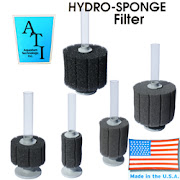
AAP Hydro Sponge Filters
THE PREMIUM Aquarium Sponge Filter with as much as 5 TIMES the bio and mechanical capacity of commonly sold Chinese knock offs!!
Definitely worth the extra $1-3
San Francisco Bay Brand Seaweed Salad
"Seaweed Salad" is much more nutritious than spinach and lettuce.
This product is recommended for all saltwater Damsels, Clownfish, and especially Marine Angels and Tangs

Hydor Smart Wave Controller
• Promotes a healthy reef aquarium or similar aquarium environment where wave action is desired by recreating natural currents found in nature
• Synchronous program for currents typical of barrier reefs and alternate for tides
For a friendly, Knowledgeable, aquarium forum with in a family atmosphere:
*Aquarium Forum; Everything Aquatic

TMC Premium Fluidized Sand Bed Bio Filters
Premium, second to NONE Aquarium Bio Filters, that with Oolitic Sand also maintain essential marine aquarium calcium levels, alkalinity, & electrolytes that are important to ALL Marine life, Goldfish, African Cichlids, Livebearers & more
Non Stop Air Pump, AC OR DC
This air pump pushes out 4L of air per minute, REGARDLESS of whether you have AC power or NOT
ADVERTISEMENT
Labels: algae, aquarium, Blue Green Algae, Cyanobacteria, cyanobacteria treatment, freshwater, red slime algae, saltwater

<< Home


