
Our Facebook Page to Follow: Aquarium/Pond Answers Facebook
This is a unique resource for answers, help, & advice to aquarium and pond questions not found elsewhere; With regular posts & article updates.
In our research; we use aquaculture, horticulture, medical, & university research to compile many of our articles.Our Recommended Lighting for highest efficiency professional planted/reef aquariums: "AquaRay Lighting"
Aquarium Algae Control; Brown Diatom, Hair, Marine, BBA, Green Spot & Water
By Carl Strohmeyer-PAMR 40+ years experience
- Brown Diatom Algae
- Common Green Algae (aka Dust Algae)
- Thread/Hair Algae
- Green Water
- Marine Hair Algae (Green Filamentous Algae)
- BBA, Black Brush Algae, Black Beard Algae, Red Brush Algae
- Cyanobacteria (Blue Green Algae)
- Planted Aquarium; Summary
Including: Whole Tank Algae Treatment using H2O2 & Glutaral Dehyde
FORWARD:
This Aquarium Answers article (post) is not intended as a complete algae control article, but is intended to address the types of algae that I receive the most questions about which are Brown Diatom Algae, Freshwater Thread/Hair Algae, Black Beard Brush Algae (BBA), and Marine Hair Algae aka Filamentous marine algae (I address other algae as well in this article). I will add to and update this article as well over time.
The information contained herein is based on my experience with literally 1000s of contract client aquariums over the years, as well as research, and feedback from other aquarium keeping professionals.
Please note that algae control is NOT an exact science and there are many methods I have not used or researched that may also work. As well, my methods may not work as well for some as all it often takes is new/different variable for an algae control method to be less effective.
It is is also noteworthy that one should start with a healthy bio filter; meaning an aquarium that is not battling high ammonia & nitrites. Many of the methods cited here for algae control address the bio filter, but some do not and those that do should be used first based on my experience.
As well, one common thread as to aquarium algae issues that emerged of late is the common use of poorly designed Chinese made LEDs that do not understand the basics of aquarium lighting PUR, often having too much light in the "blue" spectrums
The bottom line is I do not claim that this article is the "end all" for algae control, but I do think the majority of readers will find this article useful, often with information not found elsewhere.
Updated 5/10/20
Brown/Diatom Algae
 Brown Algae is not considered a true algae as per many biologists, rather a diatom. However under the 5 Kingdom classification system both Brown Diatoms and more common algae fall into the "grab bag" Kingdom; "Proctotista", although Brown Diatom Algae fall into the division Bacillariophyceae.
What is also noteworthy is there is evidence of some diatom "algae" as a green colored slime like algae instead of the much more common brown diatom algae that is a common problem with new aquariums.
 This has been called "Green Snot Algae" (scientific name Didymosphenia geminata) and is becoming more common in streams just under the surface and/or covering rocks (pictured to the right).
Also commonly known as didymo, this is a rapidly spreading invasive species of diatom.
References:
Wikipedia; Didymosphenia geminata
Didymo risk goes beyond green snot in rivers
What are Diatoms?
Diatoms also single-cell organisms but are significantly larger and more complicated than cyanobacteria. They have cell walls containing silica. The individual cells are yellow-green to brown. They contain two types of chlorophyll and at some stage in their life cycles have motile stages which move by the action of one or two tiny beating hairs called flagella.
Most diatoms show very limited mobility and exist primarily as groups of cells growing a strong film over the surface of object.
Note, cyanobacteria can mimic Brown Diatom Algae, but cyanobacteria are readily swept away with little effort while Brown Diatom Algae is not.
In low concentrations they probably don't have any noticeable effect in aquarium systems, and indeed they are probably always present.
These diatom cells are encased within a unique cell wall made of silica (hydrated silicon dioxide). The yellowish-brown chloroplasts within Brown Diatom algae are what give this “algae” its typical appearance.
Brown Diatoms are found in fresh and saltwater as well as soil. Diatoms are a major component of plankton, free-floating microorganisms of marine or freshwater environments.
Not all diatoms float freely though; many may cling to surfaces such as aquatic plants, gravel, décor, molluscs, and crustaceans.
Brown Diatom Algae are dependent upon silicates and high DOC (dissolved organic compounds) in the water and thrive in conditions where the minerals and Redox are out of balance. Brown diatom algae also out compete more desirable green algae in these conditions when light is poor for healthy photosynthesis due to lack adequate amounts of light in the proper PAR.
More about poor lighting: light in the proper PAR
With the above points in mind, I will again emphasize that Brown Diatoms MUST have silicates present to reproduce, although removal of all silicates is often not feasible. In many of the methods (outlined in the removal tips below), the aquarist can lower the available silicates such as by simply adding plants or encouraging green algae to grow which will out compete the Brown diatoms.
From the Aquarium Answers article; “Aquarium Test Kits” here are some silicate parameters:
Natural seawaters contain silicates around 10 ppm however due to differences in a closed system (which an aquarium is) and the ocean it is best to maintain silicates under 1 ppm in an aquarium to prevent diatom blooms and aid in uptake of essential elements such as Strontium by corals.
Reference: Aquarium Test Kits; Information, Review
Product Resource: Salifert Silicate/Silica Test Kit
In freshwater, silicates are generally between 4-20 ppm and should be kept under 4 ppm in an aquarium, although usually this is not a problem in healthy established freshwater aquariums where lighting is good to encourage plants or green algae (both of which will starve also consume silicates limiting diatom growth).
This is a common algae in new aquariums (including marine tanks), especially aquariums that have not fully cycled as this leaves many available nutrients for these diatoms.
If an established aquarium struggles with these diatoms, this is often an indicator of excessive silica, poor mineral/electrolyte balance, an unstable biological aquarium environment, which in turn is often caused by poor filtration, poor cleaning procedures, Redox balance, inadequate aquarium lighting or over medication.
Finally as per Silicates, do NOT confuse these with silicon/silica, as the later is inert while Silicates are not!
Silicate is made up of silicon, oxygen, and metals such as aluminium.
Keeping healthy aquarium resources:
Aquarium Cleaning, Methods, Reasons, Procedures
Aquarium Redox Potential, Reduction, Oxidation
Aquarium Lighting, PAR, lumens, CRI, watts, types and more
ADVERTISEMENT
Here are a few tips (suggestions) for eradication of Brown Diatom Algae (in no particular order of importance):
- Use re-mineralized RO or RO/DI water if silicates are high in tap water.
For saltwater 100% RO or DI water use is fine for both mixing with marine salt mix or topping off for evaporation.
HOWEVER in freshwater I do not generally recommend 100% use of RO or DI water, rather blended water and even then it is best to re-mineralize with products such as AAP Wonder Shells, and check the KH and adjust accordingly with products such as SeaChem Buffer or even SeaChem Cichlid salt which has other important minerals and KH enhancing carbonates as well.Be wary of websites that recommend the use of RO or DI water without re-mineralization for anything other than evaporation top offs as this can eventually lead to fish osmoregulation issues and poor Redox Balance.
Further Recommended Reading:
*Aquarium Fish Osmoregulation
*Use of RO, DI, Softwater in AquariumsProduct Resources:
Original AAP Wonder Shells
SeaChem Alkaline Buffer
SeaChem Cichlid salt - Along the same line of thought as the previous points, the use of products such as PhosBond or Phos-Zorb which removes silicates (and phosphates as well) can help rid your tank of the silicates brown diatom algae must have to survive.
PhosBond uses a synergistic combination that combines the safety of aluminum oxide and the higher phosphate removing capabilities of ferric oxide.
Where to find:
PhosBond from AAP
Phos-Zorb from AAP - Turning over gravel daily by hand and/or with a gravel vacuum slow the spread of Brown Diatom Algae.
- A healthy, established nitrogen cycle is essential for control of Brown Diatoms.
Good bio filtration can aid in this too, as often tanks I have seen suffering with brown algae (both marine and freshwater) have less than optimum bio filtration. A Fluidized Sand Bed Filter or even a Good Sponge Filter can help for this.
More information on:
Aquarium Nitrogen Cycle
TMC Sand Bed Filter
Premium Sponge Filter

- The use of UV Sterilization will also slow the spread of free floating diatoms and aids in the improvement of Redox Balance which is also important.
If UV Sterilizers are employed in your aquarium it is also important that these devices have their UV Bulbs replaced every six months, otherwise your UV Sterilizer will cease being effective.
Sterilizer Resources:
*The Process of UV Sterilization
*UVC Replacement Bulbs
*AAP/TMC Vecton/Advantage Premium Category 'A' UV Sterilizers - Correct lighting as per the amount in lumens and the correct PAR/PUR often usually found at about 6500 Kelvin (an incorrect PUR along with poor PAR is often the problem when lighting is the reason behind Brown Diatom Algae growth in established aquariums).
Generally lighting around 9-12 hours per day is adequate. This will allow green algae and plants to out compete the Brown Diatoms.
In marine tanks this may also indicate inadequate lumens of this high PAR light energy present in the aquarium, so even if the correct lighting is used, you may need higher energy lights (for both fresh & saltwater) such as LED Aquarium Lights or SHO Lights.
Product Resources:
*AAP/TMC PREMIUM HO Aquarium LED Lights
*SHO Lights for Aquarium, Hydroponics - Live plants (or green marine to algae in saltwater tanks) “out compete” diatoms
- Cut back on feeding or switch to higher quality foods that is less likely to produce high amounts of wastes and may also be high in silicates.
- Use near boiling water on décor, rocks (not gravel), plastic plants, etc. This is VERY effective in killing brown diatoms while at the same time allowing the establishment of healthy green algae that will often survive this procedure. I have used this method for years with excellent results.
- For freshwater aquariums, the addition of salt (sodium chloride) can aid in the control of many algae (not just Brown Diatom), however too much salt can interfere with your live plants (if you have them in the first place). I would recommend starting low, especially if live plants are present at 1 tablespoon per 5 gallons and then slowly increasing if needed.
- Snails, especially Nerite Snails (for FW OR SW).
Please see the section on snails for further links/information in this article:
"Aquarium Plants; Oto Catfish, Snails" - Oto Catfish, Otocinclus affinis , or Bristlenose Plecsostumus are fish that MAY remove and keep this algae in check in a planted tank ( I prefer Nirite snails though)
- Correct proper mineralization with products such as Wonder Shells or other mineral blocks. Maintaining a correct KH, pH, and GH balance is a good place to start as well. The use of balanced buffers in marine tanks such as SeaChem Marine Buffer is highly suggested.
More information on correct aquarium parameters:
Aquarium Chemistry; Electrolytes, GH, pH, GH, Calcium - Patience and time (about 8-12 weeks) for new tanks, often this is all it takes for a new tank.
- Please note that the suggestions using boiling water, algae eaters, and snails are methods to bring Brown Diatoms under control, however after the being "patient" with a new tank for a few months or in the case of established aquariums, these suggestions are meant for control and if their continued use is still needed this indicates other issues that need to be addressed such as organic load (DOC), lighting, mineralization, Redox, etc.


Common Green Algae (Sometimes referred to as Dust Algae)
This is the most common algae in established freshwater aquariums with or without plants.
This is the algae that coats the front and side glass. It's generally a good sign if that is the only algae that is noticeable in your tank. Generally simply scraping the glass and rinsing off plastic plants with a 1/25 bleach/water solution (followed by a rinsing with de-chlorinators and water) prior to your water change is all that's needed to control this easy to control.
Green Spot Algae
These are hard circular algae spots that take hard scrubbing too remove from the tank glass.
Moderate to high phosphate limited tanks have more problems with green spot algae on plants.
Green Spot Algae is often eliminated with increasing phosphate levels in your water. Try to maintain at least 0.3 to 0.5 of phosphates throughout the week and more preferable is in the range of 1.0 - 2.0 ppm of phosphates (however this algae is considered normal in small amounts).
Correct lighting has also been reported by many to lower the incidence of Green Spot Algae, although not eliminate it totally.
By "correct" lighting I do NOT mean necessarily more lighting, rather lighting that hits the best possible PUR with as little of yellow, and a more balanced red and green spectrum.
Reference this other article from Aquarium Answers:
PUR vs PAR in Aquarium Lighting
Some Plecostomus such as the Rubbernose may help, however these fish may also damage plants as well.
Reference:
Control of Aglae in Planted Aquaria
Thread/Hair Algae (also Blanket Weed Algae more commonly found in Ponds, may look & respond very similarly)
 Most Thread/Hair algae grow extremely fast. Most of the time hair algae come into an aquarium attached to the plant you purchased (I have seen it many times attached to the root structure of Java Fern). It can also come in as some floating fragments in the water with newly purchased fish. As well Hair Algae may be attached to snail shells (often in hard to see tiny “hairs”).
Some aquarium keepers believe that hair algae comes into an aquarium in spores and this may be how it spreads (airborne spores are more likely a problem with a pond), however there is no hard evidence to support this idea; likely the Hair Algae was probably there all the time in vegetative form, but there wasn't enough of it to be noticed until it multiplied under the right conditions.
Please click on the picture to enlarge for a better view
You can manually remove handfuls every couple of days. After eliminating this type of algae is it a good idea to add an algae eating crew.
There are many fish that may help with this;
Rosy Barbs, American-Flag Fish, Amano Shrimp, Bristlenose Plecostomus, even Platties.
Other Suggestions for control:
- A 3% bleach solution to dip new plants in for about 4 minutes can kill and thus prevent the introduction of hair algae (this can kill new plants growths on the plant dipped, so this should be expected).
- SeaChem Flourish Excel or better, NilocG's more professional formulation in "Enhance" has worked for some with this algae.
Product Resource: AAP NilocG Enhance - High levels of iron (1 ppm or more) have also been linked to thread algae.
Discontinue liquid Iron Supplements, consider the use of plant soils or Root Tabs for this nutrient in planted aquariums as excess iron can encourage hair algae growth. Iron also can come in from tap/well water.
QUOTE:
"A couple months ago I e-mailed a note to a biology professor at the local University, asking if dissolved organic carbon released by stressed plants could feed algal growth. In his reply he indicated (among other things) that he expected either phosphorus or iron to control algae growth in an aquarium.
Further, folks using PMDD have testified repeatedly that iron levels over 0.1 mg/l can cause hair algae outbreaks (as an aside, if high iron can cause algae outbreaks in a tank fed with PMDD, then phosphorus is not the limiting nutrient).
To top it off, Diana Walstad in her new book argues strongly that low iron concentrations can be an effective control on algae growth."
Reference: Hair Algae and IronAs with in ponds with hair & blanket weed algae, I have found magnets simply placed strategically in high water flow areas can actually help control these types of algae.
SeaChem Resource:
*Flourish Excel
*SeaChem Flourish Plant Root Tabs - Checking the introduction of Hair Algae (prevention) is key, as most of the time hair algae will be introduced attached to a purchased live plant.
Hair Algae may come in attached to the shells of snails, rocks collected from river/lakes, or similar. It can also come in as some floating fragments in the water containing a newly purchased fish.
There are many anecdotal stories about how a particular form of hair algae suddenly showed up in somebody's aquarium that has resulted in many believing this is the primary cause of spread, which is incorrect.
Actually, it was probably there all the time in vegetative form attached in a minute form to a plant root, rock, snail shell, etc.
Generally, while a UV Sterilizer can help aid in the spread of many algae, this is generally not the case with hair algae since it does not spread via spores and thus UV Sterilizers do not help.
This said, a true level 1 capable UV Sterilizer such as the Aqua and TMC UVs can help with Redox Balance, other algae control, and over all fish health (many sold on Amazon are not level 1 capable), so these devices are a good investment no serious aquarium keeper should be without, despite what some cut & paste anecdotal websites state. - As with Brown Algae, I have had good success with the boiling of decorative rocks, driftwood or any other "non-living" surface of hair (thread) algae attachment. Furthermore I have found after this that live plants will thrive more and better out compete so the thread/hair algae is slower to return.
- As with BBA, there is some evidence that too much light in the blue spectrum allows hair algae to out compete plants, so a tank with balanced 6500K daylight lighting is recommended and discontinue the use of any actinic/blue lights if used or the use of high Kelvin daylight lamps (such as 14,000K) in all but the deepest aquariums (higher Kelvin daylight lights may be used with 6400 -6500K for better water penetration in tanks over 24 inches deep).
If you have 10,000k or higher lighting in a tank under 24 inches I would strongly suggest switching to TRUE 6400-6500k lights (not blended, as there is a difference in spectral quality) such as the AAP SHO 6400K lights or the AAP/TMC GroBeam 6500k LED Lights.
Lighting Product Resources:
T2 6400K lights
TMC GroBeam Correct Spectrum 6500k LED Lights
GREEN WATER
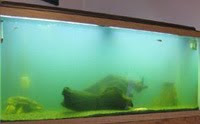 Green water in aquariums is caused by free floating algae.
Common Causes:
- High waste particulate matter in the water column (DOC), which over crowding, over feeding.
As well, improper feeding, using poor quality food that is mostly passed thru the fish, made up usually of non-aquatic amino acids and too much cereal. - Nutrients in the water column (related to the previous cause) such as Nitrates and phosphates; Nitrates should be under 40 ppm and phosphates as close to 0 as possible.
Reference: Aquarium Nitrates Control - Poor water chemistry, GH or kH to low, these are best above 100 and 50 ppm respectively depending upon fish kept. Thes can in turn affect Redox Balance which can play a minor role in a green water algae outbreak.
pH should be stable and above 6.5 in most cases. A falling or low pH combined with higher nitrates can indicate high organic decomposition in an aquarium which is a major factor in producing green algae blooms in the water column. - Aquarium not fully cycled; this is a common cause and often shows as elevated ammonia and nitrite levels. This is a common factor, if not the most common factor.
So if ammonia or nitrites are high, lowering these parameters should be followed first before ANY other steps!
Reference: Aquarium Nitrogen Cycle - Intense or incorrect lighting; the use of household standard light bulbs or cool white Fluorescents can contribute to poor lighting that encourages “pea soup” water.
Also placement of the aquarium at or near a window can also be a MAJOR contributing factor to this problem.
Corrective Measures for Green Water:
- 20% water change (or more) using a Gravel Vacuum (especially to remove nitrogenous waste (organic mulm) than often accumulates under rocks or UGF plates).
The use of products such as the Eheim Sludge Remover can help in between water changes (but these do NOT take the place of a water change)
Product Resource: Eheim Sludge Remover Vacuum - Add a UV Sterilizer.
A UV Sterilizer is almost 100% effective in the eradication of green (pea soup) water, so if you can afford this option, I would use one.
A UV Sterilizer can be basic such as the SunSun Internal/Submersible or top notch such as the TMC 8 Watt Vecton, of which a top notch UV such as the Vecton can go a long ways in aiding in Redox Balance and disease prevention and is highly recommended.
Please click on the picture above/left for a larger view of the same aquarium shown earlier after a quality, properly installed UV Sterilizer was added Where to get Quality TRUE UV Sterilizers:
AAP Internal/Submersible UV Pump
TMC Ultraviolet Sterilizer - Make sure your Nitrates are below 40 ppm (or less), and your phosphates as close to 0 as possible.
Consider products such as Algone - Lower you fish stocking.
- Electrolytes (mineral cations) such as those of magnesium and calcium. Wonder Shells are useful here so is aragonite/oolitic sand in the filter.
Product Resources:
*Wonder Shell; Premium AAP Unique Version
*Oolitic Sand for FSB Filter - Cut back on feeding and improve food quality. Better choices: HBH, Spirulina 20, AquaMasters just to name a few.
For more about proper feeding.
Please read this article: Fish Nutrition; Correct Ingredients - Increase circulation and dissolved oxygen.
- Move your tank to a different location if near a window (being next to a window is often major contributing factor).
Improve lighting to TRUE (not blended) 6400-6500K lights if low quality lights are an issue such as the AAP GroBeam LED or the Compact Fluorescent Aquarium Lights, both are available in 6500 K. - As noted in the previous section (hair algae), Magnets can be added to your filter or water lines (place away from the impeller in HOB or similar filter). Magnets work by removing iron from the water that free floating algae need for photosynthesis.
I recommend care in using magnets in tanks with live plants, although green water is often less of a problem in these tanks. - Add aquatic plants to compete with the free floating algae for nutrients, light.
- Add copper or products such as Medicated Wonder Shells that contain Copper and Methylene Blue that kill free floating algae, however even if this corrects the problem, this more addresses the symptoms than the cause from my experience.

Marine Hair Algae (Green Filamentous Algae)
 Although not the problem or scourge that red slime (Cyanobacteria), this algae can over take an aquarium in short order and is often an indicator of high nitrates and phosphates.
Although I consider algae growth generally an indicator of a healthy marine aquarium, normally I recommend less problematic algae such as the Macro-Algae as your measure for success.
Macro-algae is the 'plant' and encrusting algae that you see in many experienced saltwater aquarists marine tanks.
Caulerpa spp, encrusting corallines (a group of Red algae resembling corals), Bubble Algae aka; Valonia macroalgae (although bubble algae can become problem algae on occasion as well) are examples here.
Other beneficial algae that do not take over an aquarium include Green Gracillaria algae as these green algae are beneficial for nitrate reduction without the “overbearing problems of Green Filamentous algae which tends to take over an aquarium, often squeezing out your polyps, mushrooms, etc.
 Suggestions for control:
- For Filamentous marine algae (hair algae), I would recommend changing water with marine salt mixed with RO water only.
- The use of Phosphate reducing products can aid considerably with many marine aquarium algae problems.
NPX Bio-Plastics can reduce both nitrates and Phosphates.
Another popular product for phosphates only is Granular Ferric Oxide (GFO).
HOWEVER the use of this product can compromise your alkaline reserve and lower your pH to dangerous levels for many marine reef inhabitants, so use with careful monitoring of these parameters.
Product Resource for: NPX Bio-Plastics - Consider a deep sand bed in your aquarium (if not already present) or a separate deep sand/refugium tank for nitrate removal.
See more in this article in the Live Rock Section:
Saltwater Aquarium Basics; Live Rock, Sand, Nitrate Removal - Lower your bio load, either directly by lowering the amount of inhabitants and/or indirectly via additional filters.
See Also: Bio Load in Aquarium or Pond - Adding a protein skimmer if one is not already present.
Suggested Premium Product: TMC High Performance Protein Skimmer - Better cleaning procedures (including maintaining a 1/4 to 1/2" layer of #3 crushed coral on top of your fine sand bed for ease of trapping detritus and then cleaning).
- Finally I would suggest a clean up crew of creatures such as Trochus, Nerite, and Turbo Snails.
BBA/Black Brush Algae/Black Beard Algae/Red Algae
 Technically this is a type of red algae, but that classification does not define its appearance.
This unwanted algae that is often the "scurge" of many planted aquarium keepers grows in feathery black or red tufts 2-3 mm long, and often shows up on older parts of plants and on slower-growing plants like Anubias, Amazon Swords, and some Echinodorus.
Black beard/brush algae is a form of "red algae" in the genus Audouinella that commonly attaches to edges of plant leaves or drift wood and is more common in low CO2 water conditions, that are low in most minerals (although often high in iron), carbonates, and pH, although these algae will also grow in alkaline, high pH waters as well.
(Click on the picture to the left for another view)
This is in my opinion is the most aggravating freshwater algae I know of and I have not found a 100% magic bullet for this as of yet, although of late based on feedback of many other experts in the field, good quality lighting seems to make a big difference.
I also have plant keeping friends in hobby and profession that also want to pull their hair out when it comes to this algae, but these are the persons that have told me of late that switching from lighting such as T5 to high quality LEDs has made a big difference
This furry, thread-like flora attaches to various aquarium surfaces including the edges of plant leaves, filter tubes and even gravel. It may have many colors (purple, gray-green, black) and resembles beard hair or fur.
In the aquarium literature, this nuisance is often called beard or brush algae.
Most aquarists consider BBA to come in three forms;
- The long thread variety is called beard algae
- The shorter thread type is called brush algae
- And a third type is described as having very short threads and forms dark semi-round spots.
Physically removing rocks and wood that have these algae on it and then scrubbing it off will also give plants a better chance of utilizing nutrients and over coming these algae.
The use of Sea Chem Flourish Excel often in double or even higher doses has been shown to be occasionally helpful in control of this algae (although not as well as some other algae such as Hair Algae).
Part of the reason for some effectiveness by Flourish Excel (or better, AAP NilocG Enhance) is that this product slows algae growth on plant leaves allowing the plant to out compete the algae for nutrients (including carbon and light).
Another part of the reason behind some effectiveness by Flourish Excel is the Aldehyde based formula. Aldehyde are effected by oxidation which is another indicator of the importance of VERY regular but often small water changes (as much as 5-10% per day) to bring about a healthy Redox (among other methods of Redox control).
This admittedly is only a theory at this point, however I have observed vastly better algae control (of all sorts of algae) in ponds where I achieved a healthy Redox via flow through water changes, mineralization and a PROPERLY installed TRUE Level One UV Sterilizer (not a UV Clarifier ONLY such as many of the Submariner, AquaTop, etc.).
Reference: Redox in Aquarium
Product Resources:
SeaChem Flourish Excel from American Aquarium
*True Level 1 UV Sterilizers for Aquarium/Pond
A few ideas for removal/control of BBA
(Please see the summary of this article for more general algae control ideas that can apply to BBA as well)
- Balance your ferts.
This includes iron at 0.1-0.5 ppm Iron (Fe) and a minimum of 75 ppm GH (4 dGH).
I strongly recommend the use of balanced ferts such as AAP Professional Treatment's "Grow-It", NilocG "Thrive All in One", or AAP "NPK" Macros AND Micros Set.
Resources:
*AAP Grow-It
*AAP NilocG Aquatics; Planted Tank Liquid Ferts - Do NOT use actinic lights or even 50/50 lights that contain actinic (blue) light as I have found BBA thrive on this light more than plants and will out compete with plants for essential nutrients, making it difficult to keep the leaves free of BBA.
I strongly recommend 6000-7000 K lights ONLY!
More importantly, a 6500K light with balanced red and blue spectrums, with as little yellow light spectrum as possible has been shown considerably of late to make a big difference in control of BBA.
To be VERY BLUNT, the light that has made a big difference has been the high output GroBeam LED lights, NOT standard Low output T8 or even many T5, and NOT the low end LEDs being peddled in many forums such as the Finnex and Fluval LED lights.
Here is an interesting quote a person who keeps many planted aquariums that I know that address the BBA issue:
"I use Flourish excel a couple times a week. Usually it is standard dosing but if an algae problem should arise I will on occasionally double or triple dose once. The BB algae issue has been MUCH less with the GroBeam LED lights than prior T5 lighting"
See this article for more: Aquarium Lighting; PAR
Recommended Product Resource:
American Aquarium GroBeam LED Lights
Why is this?
BBA algae in particular along with Cynobacteria and to a lessor degree all other photosynthetic algaes (including symbiotic zooxanthellae) have Phycobilisomes which are light harvesting antennae of photosystem II (Chlorophyll synthesis in the Photosynthic Action Spectrum-PAS).
So when we emulate this deeper water light, we provide an advantage to algae, in particular BBA, over plants that do not have these Phycobilisomes and thus cannot compete as well in necessary photosystem II (Chlorophyll synthesis).
This is noteworthy as each phycobiliprotein has a specific absorption and fluorescence emission maximum in the visible range of light. Consequently, their presence and the particular arrangement within the phycobilisomes allow absorption and unidirectional transfer of light energy to chlorophyll a of the photosystem II.
In this way, the cells take advantage of the available wavelengths of light in the 500-650 nm range, which are inaccessible to chlorophyll, and utilize their energy for photosynthesis.
This is particularly advantageous deeper in the water column, where light with longer wavelengths is less transmitted and therefore less available directly to chlorophyll.
This is why that while blue light carries more energy, we know based on these Phycobilisomes that there is more to light than just energetic photons and that certain wavelength are better for for certain photosynthetic life.
We can only over come this advantage of these algae by pumping copious & unusual amounts of CO2 & other nutrients (ferts) into our aquarium (assuming still some form of "white" light containing light within the higher PAS spikes for our aquatic plants, as if ONLY blue light is used, overcoming this advantage would be difficult if not impossible).
See the picture above/right of a Phycobilisome structure.
Reference; Wikipedia; Phycobilisome - Related to the above suggestion; some aquarium professionals I trust have reported some effectiveness in controlling BBA by setting lighting timers to include a 2 hour "OFF" cycle in the middle of the day (I personally have not done this to control BBA in my tanks).
- I have also found (as in Brown Diatoms) that pouring near boiling water over decorations such as rocks or filter returns, etc. that have BBA on them works well for killing this algae while allowing establishment of much less onerous green algae.
- Siamese Algae Eaters (SAE) are very good at keeping these algae in check (providing that there is not more tasty green algae or left over fish food).
Some other fish such as Platties and Rosy Barbs will occasionally snack on BBA as well.
Shrimp such as Amano and Cherry Shrimp.
As well as Nerite Snails can work for control of BBA (other snails may work, but may result in the "double edged sword" of a snail population explosion). - As noted earlier, low CO2 levels and incomplete fert use in planted aquariums has been reported by some to be a cause, so increasing your CO2 levels to at least 10 ppm (or more) along with a better fert dosing method may help.
Here is a product I would recommend for vastly better fert dosing (based on EI method):
AAP/NilocG EI Planted Aquarium Dosing - Trim and remove leaves from plants "losing the battle" to BBA. This more easily allows the plant to grow new leaves that will hopefully out compete the BBA assuming conditions right or are now improved for the plants.

The use of baths/dips for treatment of BBA:
Sea Chem Flourish Excel can be used as a quick dip solution (about 30 seconds) for plants to kill algae.
I recommend diluting with about 5 parts water with 1 part Flourish Excel, however I have not established an exact dilution as of yet (so experimentation may be necessary).
Hydrogen Peroxide can also be used as a dip/bath (or even added directly to the aquarium), this can be especially effective for the control of Black Beard Algae.
When added directly to the tank, this is best at a rate of 2 oz. of 3% Hydrogen Peroxide per 10 gallons.
HOWEVER this is best done WITHOUT shrimp (such as Cherry Shrimp) present, as this will generally kill them. As well many fish are sensitive to Hydrogen Peroxide, such as Cory and Oto Catfish, so my preferred use is as a dip/bath.
Even then some plants are sensitive as well such as Corkscrew Vallisneria, so experiment with Hydrogen Peroxide in small amounts if unsure or simply use my preferred method baths/dips which is Flourish Excel as noted earlier.
For plant baths, I would recommend about 4 oz. of 3% Hydrogen Peroxide for approximately 30 minutes. For a 30 second dip, about a 5 to 1 solution of Hydrogen Peroxide applied by basting the plants with the solution (this solution can be increased if results are not satisfactory).
Please read this article for about the use and risks of Hydrogen Peroxide:
Aquarium Medications Part 3; Hydrogen Peroxide
Finally as I noted earlier about BBA, it can be a frustrating algae, however I have often found it much simpler to control this algae rather than pull my hair out in trying to totally eradicate it.
This is often easily done with some of the suggestions in the summary of this article (please read further), such as trimming of leaves with the BBA, scraping of these leaves as well, correct lighting (meaning 6500 K high PAR lights and no actinic), good mineralization, added CO2 which includes methods such as Flourish Excel in its bio available liquid form, regular water changes, and more.
Cyanobacteria (Blue Green Algae/ Red Slime Algae)
Blue/Green Algae which is more appropriately called Cyanobacteria is more closely related to bacteria than algae. Cyanobacteria can be a difficult problem in both fresh and saltwater.
Cyanobacteria is more common in a tank that is not healthy or that has a high load of dissolved organics.
Cyanobacteria has many species and forms and causes great angst among planted tank beginners and experienced hobbyist alike. Some forms of BGA grow slow and are very difficult to kill, other species grow very quickly and can overwhelm and "smother" all the plants in short order.
For my full discussion of Cyanobacteria, please see my separate article about it:
“Cyanobacteria (Red/Orange Slime, Blue Green Algae) in Aquariums”
PLANTED AQUARIUM ALGAE PROBLEMS (SUMMARY)
Most true algae (not Cyanobacteria) compete with plants for the same nutrients and light, so battling algae is often very difficult.
However from my experience with ponds in particular it is often a “battle” than cannot be totally won but certainly can be checked by keeping nutrients away from algae (such as substrate nutrients) while providing them to plants and understanding that algae are more simple life forms than plants and have less complicated needs, so addressing the more complex needs of higher plants will allow them to out compete.
Sometimes this is as simple as removal of as much algae as possible to give the plants a foot hold, although this can also be a much more difficult task.
Often just lighting, just ferts, or just CO2/carbon issues are blamed, when in fact it is generally combination of all.
For instance if you improve light, you will also need more CO2, and often more nutrients. Failure to provide CO2 and nutrients while improving/increasing lighting, will often result in more algae and poor plant growth.
A couple resources to simply improve CO2 & Nutrients (Ferts)
*ISTA Co2 Disposable Cartridge Supply Set from AAP
*AAP; NPK & All in One Planted Aquarium Ferts/Nutrients
Here are some factors that MAY affect unwanted algae growth in your planted aquarium;
*Unusable/Unavailable nutrients (micronutrients and macronutrients) as well as Nutrient Imbalance.
Here is a list of important nutrients (listed in recommended added solution, not ppm as stated earlier in the article):
Potassium (often available as Soluble Potash)- .37%, Iron- .32%, Sulfur- .27%, Sodium- .13%, Calcium- .14%, Magnesium- .11%, Nitrogen- .07%, Nitrogen- .07%, Available Phosphate- .01%, Boron- .009%, Cobalt- 0004%, Copper- .0001%, Zinc- .0007% Molybdenum- .0009%,.
Here are a few product sources:
- Sea Chem Flourish Liquid & Root Tabs from AAP
- AAP; NPK & All in One Planted Aquarium Ferts/Nutrients
- PMDD
- Regular Wonder Shells (from AAP)
Not all these sources have all the required nutrients many can be mixed as you find your own success.
Much has been published lately about the addition of PO4 (phosphates) to control algae, however I believe this is only partially correct and based on some false assumptions.
PO4 along with NO3 and Potassium are important Macronutrients that need to be in balance.
I have found that simply changing water will (assuming proper mineralization of new water) will control algae by adding all these macronutrients.
What is happening is that algae are much better equipped than higher plants to compete in conditions of low nutrients, however the addition of these nutrients allows much better competition.
Adding only PO4 does not bring these macronutrients into balance and even though many claim this solved their problem, they have not run a control group to see if this was only part of the equation.
*Important! - Poor lighting or Too Much Light; Poor Lighting quality that does not allow plants to compete with algae can be a cause of difficult algae issues.
Although when more useful light energy is added more nutrients including CO2 are needed.
I do not agree with the method of darkening a tank for a few days as plants often have higher light requirements than algae (in part due to their complexity), this only gives the algae more time to out compete plants!
However as per the Walstad/German method of planted aquarium keeping, you can interrupt the lighting schedule in 4 hour increments. In other words, leaving the light on for only 4 hrs at a time (this though does assume optimum spectrum lighting).
Example: Lights on @ 8 am, then turn lights off from 12 pm. Then again turn lights back on @ 4 pm until 8 pm for the rest of the night.
Basically only using your tank light for 8 total hrs per day, with a 4 hour break, in the middle of the "lighting period".
The purpose is:
- To cut back algae by starving it of the necessary length of light exposure it needs to grow.
- To boost plant growth by allowing CO2 to build back up naturally during the mid-day lighting break, thus providing the plants more CO2 to use during the second Photosynthesis period, which starts when your lights go back on for the evening.
During this time, if using plant nutrients, try cutting back on the dose used and or frequency of use, as any nutrients in the water that go unused by the plants will go to algae.
Further Reference, a MUST READ:
Aquarium Lighting; Complete Information
*Poor substrate for healthy plant growth (only certain plants!).
Make sure your substrate is rich in Iron (Fe).
Iron is an important trace element; your tank substrate should contain a reasonable amount of Iron.
Liquid iron will, if over dosed, favor Hair algae. It can be added through tablet Iron rich fertilizers and through substrates like SeaChem Fluorite, Laterite and EcoComplete
Product Resource: SeaChem Fluorite
*High or too low Nitrates.
Nitrates should be between 10 & 15 ppm for plants; with nitrates above 40 ppm, I have seen excessive algae growth in many aquariums (although high nitrates are rarely a problem in tanks with healthy plant growth).
Too low and plants will starve for this important macronutrient.
Further References:
*Freshwater Aquarium Plant Care
*Nitrates in Aquariums, Ponds
*Aquarium Cleaning Frequency.
Often increasing the frequency (even twice or three times per week) will improve conditions in the aquarium so as to allow plants to out compete algae.
In part this improves the macronutrient balance as discussed above (as well as improvements in Redox and lowering DOC).
Further Reference: Aquarium Cleaning, Reasons, Frequency, Methods
*Trim plants of dying, decaying, or algae covered leaves, even if this removes much of your plants.
This is much like pruning in your garden. This forces plants to generate new and healthy leaves that will often do better at out competing algae.
*Dip your new plants or even established plants, although this will cause a temporary shock to established plants.
Here are a few dip methods;
- Bleach used in a 20 to 30 parts water to 1 part bleach for 2-3 minutes for delicate plants and 4-5 minutes for broad leaf plants; followed by a quick dip in sodium Thiosulfate or other de-chlorinator/ water mixture (Sodium Thiosulfate is found in many aquarium/pond de-chlorinators such as Start Right and I recommend that the dose used to neutralize the bleach be double to triple the normal suggested amount for tank use).
- Potassium Permanganate in a solution of water and enough Potassium Permanganate to turn you water pink for 20 minutes is also effective for many algae, diseases and usually snails, again followed by a sodium Thiosulfate or other de-chlorinator/ water mixture.
- Hydrogen Peroxide can be used as a 30 second dip in a solution of about a five to one, water to 3% Household Hydrogen Peroxide applied by basting the plants with the solution (this solution can be increased if results are not satisfactory).
- Sea Chem Flourish Excel, this product can be used as a quick dip solution (about 30 seconds) for plants to kill algae. I recommend diluting with about 5 parts water with 1 part Flourish Excel.
Also the dosing of Flourish Excel in your aquarium can be effective for algae control as well.
Flourish Excel contains a polymerized isomer of glutaraldehyde trademarked as polycycloglutaracetal by SeaChem and is the active ingredient in this product, which is a fertilizer for aquatic plants.
It is claimed that it provides a bioavailable source of carbon for higher plants that is not available to algae. Though not marketed as such due to federal regulations, the algaecidal effect of glutaraldehyde kills most algae at concentrations of 0.5 - 5.0 ppm.
Product Resource: SeaChem Flourish Excel, New Plant Dip, Bio Carbon
*Improper GH and KH levels (or mineralization, especially GH).
Here is an important point:
“The release of carbonate converted from bicarbonate by plant life can cause pH to climb dramatically (above 9) during periods of rapid photosynthesis by dense phytoplankton (algal) blooms. This rise in pH can occur in low alkalinity water (20 to 50 mg/L) or in water with moderate to high bicarbonate alkalinity (75 to 200 mg/L) that has less than 25 mg/L hardness.”
* UV Sterilization;
Despite many claims that a UV Sterilizer can only kill free floating algae, I have found evidence in many tests that a UV Sterilizer can control (not eliminate) the spread of some algae.
I do not have a conclusive answer as to why I have found these positive results with algae control in aquariums (& ponds) with the use of UV Sterilizers/Clarifiers, however I suspect the reason is twofold:
(1) The UV Irradiation kills algae spores, thus slowing the spread (as noted earlier, algae that spread "vegetatively" such as hair algae may see little improvement with the addition of a UV Sterilizer).
(2) Improvement in water conditions such as Redox Balance via TRUE level 1 UVC Sterilization
Further Reference: True UV-C Sterilization for Aquarium or Pond
*A poor Redox Balance/Potential; which is often improved by better and more frequent water changes and proper mineralization such as Calcium, Magnesium and sodium as stated above.
 *The use of either all Reverse Osmosis water or blended (such as 1/2 or 1/4 mixed with tap or well water) can aid in many algae control as this allows the aquarium keeper to adjust water chemistry more from a "clean slate" approach especially where tap/well water contains high phosphates, nitrates, iron or similar elements/nutrients that favor algae.
Be aware that it is important to add essential minerals and carbonates back into RO water with products such as SeaChem Replenish or Wonder Shells.
See these articles for more about Reverse Osmosis (RO) water use:
Aquarium Chemistry
Use of Reverse Osmosis Water In Aquariums
Product Resources:
*Reverse Osmosis Water Filter System for Aquarium
*SeaChem Replenish; RO Water Mineral Adjuster
*Wonder Shell; Aquarium, Pond Mineral Blocks (unique AAP)
Whole Tank Algae Treatment using H2O2 & Glutaral Dehyde
Sometimes simply "nuking" your planted tank is the most simple way to get rid of unwanted algae, regardless of the cause.
Here is a method from:
PlantedTank.net: The "One-Two Punch" Whole Tank Algae Treatment
- Flow is essential for success here.
Adding extra power heads for flow is advised (or even air bars/stones) .
If your only source of flow, water movement are your filters, you will have to temporarily remove the filter media to a bucket of tank water, and leave the filters on. - If you have Marimo balls, temporarily remove them to a bucket of tank water as well.
Cladophora is very hardy, and normally not affected by whole tank H2O2 (Hydrogen Peroxide) treatments. But this treatment can burn them badly, especially on sides exposed to direct flow. If they're also infested with undesirable algae, they can be treated simply by keeping them in the bucket in a dark place for a week. Cladophora can tolerate extremely long blackouts without harm, unlike other algae. - Keep the lights on. Light has no effect on the H2O2, but is helpful in observing your results.
- Now add 3% H2O2, at a dosage of 4 tablespoon per 10 Gallons (38 liters) of actual tank water volume (excluding substrate, plants, etc).
Allow to circulate for 15 minutes. During this time, redirect flow a few times if possible, to make sure all areas get covered. If you have particular trouble spots, try to ensure they get direct flow during part of the treatment. - Now terminate the treatment, followed by a 50% water change, or more. Return the tank to its normal configuration, including replacing filter media if it was removed.
Less hardy algae may be effectively killed by this alone, especially if flow was good. But all algae will be weakened. - Any remaining algae not killed by the H2O2 is now extremely susceptible to Glutaral Dehyde (AAP/NilocG Enhance or SeaChem Flourish Excel).
Product Source: AAP/NilocG Enhance; Glutaral Dehyde - If you weren't already using Glutaral Dehyde, or were using it at the recommended dose, add NilocG 's recommended "after water change" high dose of 5ml per 10 Gallons.
No further large doses are necessary in this case. Algae builds up some tolerance to Glutaral Dehyde, similar to sensitive plants like Vallisneria.
In this case, the H2O2 treatment followed by a single, sudden Excel spike is enough to quickly finish algae off. - If you were already using Glutaral Dehyde high doses, continue using the previous dose.
- Your aquarium should now be algae free!
If there are any underlying problems that caused the algae outbreak in the first place, correct them so your tank stays algae-free. In some cases, a thorough algae removal like this is enough to improve plant health to the point where algae will not return assuming proper parameters, ferts, light, and carbon dosing.
Further Reading/References:
*The Krib; Control of Red Algae in the Freshwater Aquarium
*The Krib; Hair (thread) Algae
*Introduction to Bacillariophyta (The Diatoms)
*Planted Aquarium Keeping Information
*A Discussion of Algae
Other Recommended Reference & Product Sites

Fish Diseases | How to Treat Sick Fish

Saltwater Aquarium Information; Basic to Advanced


Sponge Filtration; Complete Sponge Filter Use Information
*Aquarium Silicone; USDA 100% Fish Safe
100% Fish Safe, USDA & Agricultre Canada approved.
The same CANNOT be said for Hardware Store brands!!

TMC Premium Fluidized Sand Bed Filters
Premium, second to NONE Aquarium Bio Filters, that with Oolitic Sand also maintain essential marine aquarium calcium levels, alkalinity, & electrolytes that are important to ALL Marine life, Goldfish, African Cichlids, Livebearers & more

The Premium ATI Hydro Sponge Filter, from the only online seller with professional use dating back to 1978 (prior to the Internet)
San Francisco Bay Brand Seaweed Salad
"Seaweed Salad" is much more nutritious than spinach and lettuce.
This product is recommended for all freshwater Algae Eaters, African Cichlids, Silver Dollars, Sharks, all saltwater Damsels, Clownfish, and especially Marine Angels and Tangs
TMC V2 RO Filter systems; the very best you can buy with TDS meter:
 Reverse Osmosis Aquarium Water Filters; with TDS Meter
*Wonder Shells, Mineral Block
ADVERTISEMENT
Labels: algae control, Aquarium Algae, Blue Green, Brown Algae, Brown Diatom, Cyanobacteria, green algae, Hair Algae, red algae, Reef Algae, Thread Algae

<< Home


