Our Facebook Page to Follow: Aquarium/Pond Answers Facebook
This is a unique resource for answers, help, & advice to aquarium and pond questions not found elsewhere; With regular posts & article updates.
In our research; we use aquaculture, horticulture, medical, & university research to compile many of our articles.Our Recommended Lighting for highest efficiency professional planted/reef aquariums: "AquaRay Lighting"
Aquarium Power Failure | Tank Moving
*Aquarium Moving (Part 1)
*Dealing with Power Failures (Part 2)
By Carl Strohmeyer-PAMR 40+ years experience
Updated 2/25/20
AQUARIUM MOVING
There are many different methods for moving that work well, I will give you information on the moving method that has worked best for me when I moved aquariums, both small and large for my aquarium maintenance clients (some short distance, a couple as far as 800 miles).

- Purchase some sterile Rubbermaid containers or Coleman or similar style ice chests (not cheep "styro" ice chests) as well as buckets for ornaments, gravel, etc.
If Rubbermaid containers are used, I prefer as large as possible such as 32 gallons for tanks over 40 gallons.
I would also suggest a good washing with a strong salt water solution prior to use (water softener salts is cheap and works fine for this). - Drain water from the display tank into one of these containers. Do not fill more than you can move or will spill. Then add your fish to this water.
- Add Premium MethyBlu (or regular Methylene Blue), this will aid in the oxygen capacity of the blood, ease stress, ease ammonia/nitrite poisoning and help prevent disease (I generally do not recommend the use of Methylene Blue with Invertebrates).
I also added AAP Wonder Shells as these would increase the bio load capacity of the water and add very important electrolytes (Cations) and aid in water parameter stability.
In fact I've moved fish tanks both with and without the use of fresh AAP Wonder Shells, and those with the AAP Wonder Shells had fish arriving in better shape and lasted longer without oxygen & filtration.An additional helpful product would be SeaChem's StressGuard which is useful to reduce stress and ammonia toxicity. Another advantage of adding StressGuard to your fish moving container is that it provides a slime coat protection via a protein active colloidal agent which actively seeks out any wounds, abrasions, or places where exposed proteins are and attaches to this area to help directly.
Keep this container as dark as possible.
Where to purchase:
*AAP MethyBlu (Premium Methylene Blue)
*Kordon Methylene Blue from AAP
*AAP Wonder Shells (fresh)
*SeaChem StressGuard from AAPAnother alternative (not what I generally do, but many prefer) is to bag all your fish adding oxygen or the newer breathing bags.
You can also add Methylene blue and AAP Wonder Shell "Chips" for stress and disease prevention.
This is a perfectly good method, However I just prefer the first method as to be able to monitor and even aerate my fish. I also have arrived with less stressed fish this way (including versus using the breathable bags), as in my opinion the fish feel more comfortable in a larger container with less ammonia buildup and more cover. - For trips over 4 hours, I often suggest a battery air pump or AC air pump plugged into an inverter that runs off the vehicles cigarette lighter.
Admittedly I've made many long trips (including several from Southern California to Oregon) without air pumps, simply following the earlier noted AAP Wonder Shell along with MethyBlu method, but this increases odds for long trips, especially with delicate fish
My recommendation here is to use the AAP AirPod Non Stop Air pump (pictured) or similar as this VERY powerful pump (more powerful than many standard AC pumps) can run up to 20 hours and can also be used as an automatic emergency air pump during power failures or simply as your aquariums main air supply pump.
There have been many versions of this pump under different manufacturers, in the beginner with a power pack, but the problem with the power pack (rechargeable battery), is being plugged in all the time slowly killed these batteries (think of how your "lap top" computer battery dies slowly if not exercised), so when needed, it did not run as long as promised in the beginning. As well, customer feedback (& my own experience with my clients) showed that most customers wanted to be able to pop out batteries and replace when they ran out during extended power failures since charging was often not an option.
Where to purchase: AAP AirPod Non-Stop AC/DC Air Pump The other alternative are the very simple battery pumps that run on ‘D’ cell batteries. These pumps are not all that powerful, however these pumps such as the AAP Automatic Battery Air Pump (pictured to the left) often provide ample air down to at least 18 inches of water and can last up to 8 hours when using fresh alkaline batteries.
Where to purchase: AAP D Cell Battery Aquarium Air Pump
The inverter can also be used to run a standard submersible heater if needed, such as a 50-100 watt, as most standard modified sine wave inverters designed for automotive ports can run up to 200 watts (some automotive ports are limited to 120 watts, but then a 50 watt heater will still work).
Suggested source for submersible aquarium heaters:
Aquarium Heaters - Do not over rinse any gravel or bio filter media such as sponges; place these in an open container/bucket so as to keep the aerobic bacteria alive for your aquarium nitrogen cycle (these bacteria must have dissolved oxygen in the water).
Reference: Aquarium Nitrogen Cycle - Place safe (not heavy) decorations in with fish to provide cover. For live plants keep them separately as you will deplete oxygen in the darker moving environment. The same for rocks and heavy decoration as these can injure the fish.
- Discard any unused water, however I do utilize transport water to later mix with the new tank water to ease pH stress (more later).
For marine tanks I try and save as much water as possible. - For small tanks (usually under 40 gallons), I will generally leave some gravel and other equipment in the tank for quick moving. For larger tanks I remove everything.
- Once at the destination, I begin to re set up the aquarium.
For marine tanks I immediately start up a container with an air stone, water (preferably RO) and salt mix so as to have mixed saltwater ready for use. I will also note that I prefer 24 hours of agitation of newly mixed saltwater before using, however this time is usually not an option when moving. - Once the tank is set up and running, I start SLOWLY mixing water back and forth between the tank and fish container to prevent osmotic & pH shock, and adjust temperature.
I will usually add AAP Res-Q (freshwater or Shieldex for marine) to the container holding the fish and more also add SeaChem Prime to the display tank just before addition of the fish (and other aquatic creatures).
I also strongly suggest adding AAP Bettamax at double dose to the fish holding container during the last 20-30 minutes of acclimation for disease prevention and added stress relief.
Where to purchase:
SeaChem Prime Premium Water Conditioner from AAP
AAP Bettamax
AAP Res-Q
AAP Sheildex


Moving Summary;
This is not the one and only method to move aquariums (and the inhabitants), but this way and variations of this method have worked very well for me with almost no losses over dozens of moves for my clients.
I also still use the MethyBlu (Methylene Blue) with AAP Wonder Shell along with AAP Bettamax & AAP Res-Q upon arrival method in transporting fish from LA to Oregon a few times a year (counting stopping time this is a 36 hour plus journey for the fish without a loss yet!)
For a much more in depth Aquarium Answers article that deals specifically with shipping of fish, as compared to this article that is aimed more at transport of fish and aquariums, please see this article: “Fish Shipping”
ADVERTISEMENT

It is also noteworthy that most healthy aquariums (with normal bio loads) can last up to 4 hours with absolutely no action taken! However with high bio loads per filter/aquarium carrying capacity, this time may shorten considerably where fish and the bio filter may suffer.
Here are several suggestions:
- Stirring the aquarium with a small clean paddle. This can be done gently enough to not cause too much stress to fish while providing water moving and oxygen/CO2 exchange (depending on paddle size and aquarium size; obviously a smaller paddle for a smaller tank).
- Keeping a Battery automatic air pump connected at all times to the aquarium. The best way is via a small Sponge Filter as pictured to the left, although for better yet effectiveness in removing ammonia/nitrites, I suggest that a separate sponge filter be connected to a continuous running pump then this Sponge filter be reconnected to the battery pump during the power failure.
An example of where this saved a client's aquarium was a client with a single marine aquarium in a small strip mall. The mall had a major fire, yet the aquarium kept running and while some acrylic trim warped, all the fish survived to both the firemen and client's amazement.
Where to purchase: Aquarium Battery Air Pump - This same idea as above can be used except a Non-Stop Battery pump is employed so that the Sponge filter is always biologically seasoned or does not require reconnection to the battery air pump during power failures.
Where to purchase: Non Stop Air Pump, AC/DC Heavy Duty for power failures - The use of a DC to AC inverter (which is then connected to an Deep cycle RV Battery. I have found that a fully charged deep cycle battery can run the average aquarium for days without re-charging.
This application is even better for aquarium rooms where multiple aquariums are present.An example where this application made a big difference was during a rolling black out in Los Angeles Suburbs.
In a local fish store I set up, during one of the rolling black outs, our deep cycle batteries with inverters kicked in and ran critical functions including cash registers. A local news crew (KFWB) was driving by and could see that we were still open for business and interviewed our staff. A fully charged Series 24 Deep Cycled RV Battery can run 100 watts of appliances (pumps, etc.) for a good amount of time, with two connected in parallel you can double your output time.
This can also run a heater, but keep in mind that a 200 watt heater (as an example) can take out even a heavy duty/deep cycle RV battery in a short amount of time.
If you do decide to keep an inverter, make sure to get the largest and best you can afford. My suggestion is a 400 Watt modified or better pure since wave inverter as a minimum.
The battery and inverter can be kept in a closest or garage with a trickle charger attached ready for any emergency.
Here is a great online calculator to figure your power needs and run times:
Calculator | DC to AC amperage conversion run through an Inverter
Using this calculator; we can see at 1/2 (.5) amp AC (60 watts), this will come out to 5.52 Amps DC (12 volts). This would mean a deep cycle battery with 25 amp max discharge with 120 minutes reserve would in theory (best conditions) run for 543 minutes or 9 hours - A UPS (Uninterrupted Power Supply) is another similar and more simple option to the Deep Cycle Battery/Inverter option.
However this option does not have nearly the energy reserve that a good deep cycle battery will provide and is generally only good for one small to medium sized (10-60 gallon) aquarium. Generally one can expect 2 hrs 30 mins run time for 50 watts (an average canister filter).
- A generator is always one of the best options when available since 1000 watts or more are easily generated with most models (make sure these have at least a modified sine wave as with any inverter).
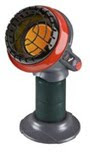
The generator unfortunately may not be feasible for many city apartment dwellers, which is where the above (& below) suggestions are likely more practical. - During Winter, heat can become an issue, beside the use of a deep cycle RV battery or a generator, you can utilize a catalytic propane heater (with a window slightly vented) to heat the room with the aquarium. This can at least keep a room from plunging into the 40s and the likely death of any tropical fish.
See the picture to the left. - The use of AAP Prime or Amquel Plus is also suggested if ammonia or nitrite levels rise during power failures.
Where to purchase: SeaChem Prime; Detoxifies Ammonia and Nitrites - Water changes (if you are on city water, not a well that needs AC power) can also be used to provide fresh water, electrolytes, & oxygen. As well products such as AAP Wonder Shells also add essential electrolytes and even some oxygen.
Other Recommended Reference & Product Sites

Aquarium and Pond Information, Help, Advice Articles

Fish Diseases | How to Treat Sick Fish

Best Aquarium Lighting, Reef, Planted, Basic, Advanced


Aquarium Chemistry; Basic to Advanced, Saltwater & Freshwater

POND CARE INFORMATION; Complete Steps

Freshwater Aquarium Care; Basics to Advanced

Eheim Everyday Automatic Feeder
"The EHEIM Everyday Fish Feeder is a compact fish feeder with actively aerated feeding chamber.
This unit includes a clamp for fixing to open top aquariums or terrariums. Easy to understand programming, double dosage of food is programmable."
Planaria & Detritus Worms in Aquarium

SunSun HBL Power "Hang On Back" (HOB) Aquarium Filter
211 Gallons Per Hour Flow Rate (800 LPH)
For Aquariums up to 40-45 Gallons
The Best in Value UV Sterilizers:
*Aquarium & Pond UV-C Sterilizers/Clarifiers

COMPACT UV STERILIZERS, Terminator 7 watt to 36 watt
ADVERTISEMENT
Labels: Aquarium Moving, Aquarium Moving tips, Aquarium Power Failure, Battery Air Pump, Fish Moving, Power Failure fish, tank moving

<< Home